PRIN22: BeSaME - Helicopter Blade State and Loads Reconstruction Through Virtual Sensing for Health Monitoring and Performance Enhancement
PRIN22: BeSaME - Helicopter Blade State and Loads Reconstruction Through Virtual Sensing for Health Monitoring and Performance Enhancement
Project Description
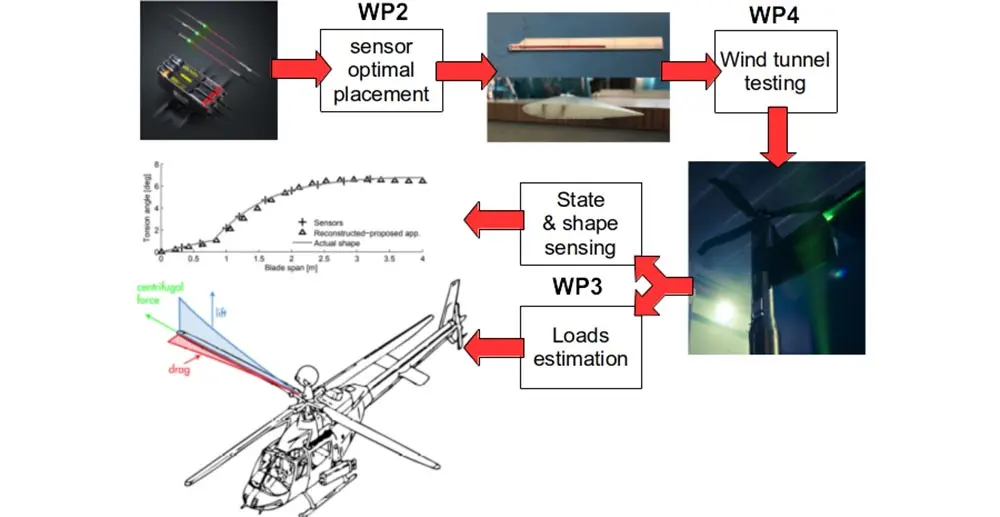
BeSaME is a research project aimed at developing advanced technologies for the real-time monitoring of helicopter rotor blades. The project addresses key challenges in rotorcraft safety, damage detection, and maintenance by enabling the reconstruction of blade shape, aerodynamic loads, and system states directly from embedded strain measurements.
The core idea of BeSaME is to replace or complement traditional sensor-intensive monitoring systems with a virtual sensing framework. By combining a limited number of carefully placed and specially oriented embedded fiber-optic sensors with high-fidelity numerical models and state-estimation algorithms, the system can infer quantities that are otherwise difficult or impossible to measure directly on rotating blades, especially outside controlled test environments.
The project leverages fiber Bragg grating (FBG) sensors, embedded within composite rotor blades to measure axial and shear strains during operation. These measurements are processed using inverse finite element methods and state-estimation techniques, including augmented Kalman filtering, to reconstruct blade flexural and torsional deformations, sectional loads, and the overall system state in real time. A key aspect of the work is the optimization of sensor placement, ensuring high reconstruction accuracy while minimizing the number of required sensors.
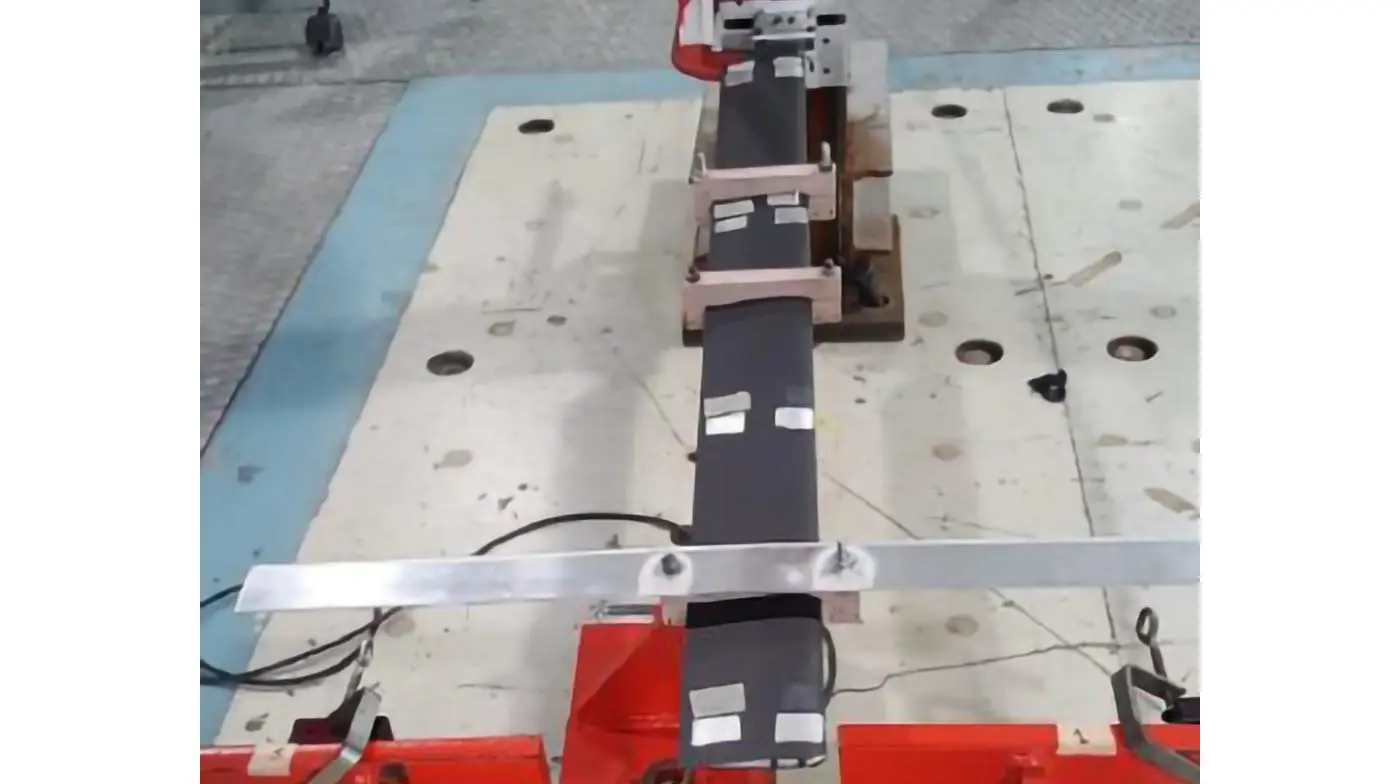
To validate the proposed approach, the project includes the design and manufacturing of aeroelastically scaled composite rotor blades with integrated optical fibers. Innovative integration techniques, such as the Quick-Pack method, are employed to ensure precise sensor positioning and robustness. The blades are tested through a comprehensive experimental campaign, including static tests, modal characterization, and rotating-rig tests under representative centrifugal and aerodynamic loads.
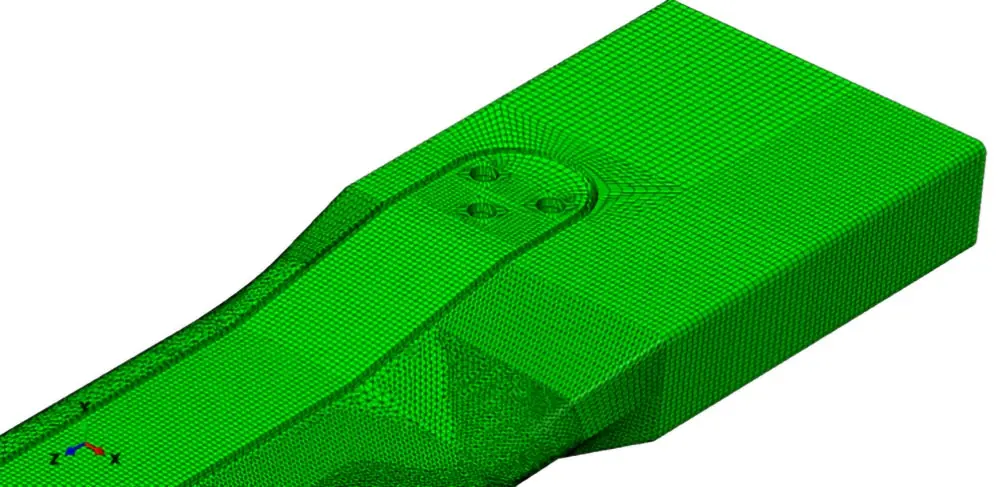
In parallel, a digital twin of the blade and rotor system is developed by combining detailed finite element structural models with aeroelastic simulations employing free and open-source software developed in-house, such as MBDyn and DUST. Experimental data are used to continuously update and validate the models, improving prediction accuracy and confidence in the virtual sensing framework. The resulting experimental database and numerical models will be made available to the research community, constituting an open benchmarking tool for the modeling and analysis of aeroelastic rotorcraft systems.
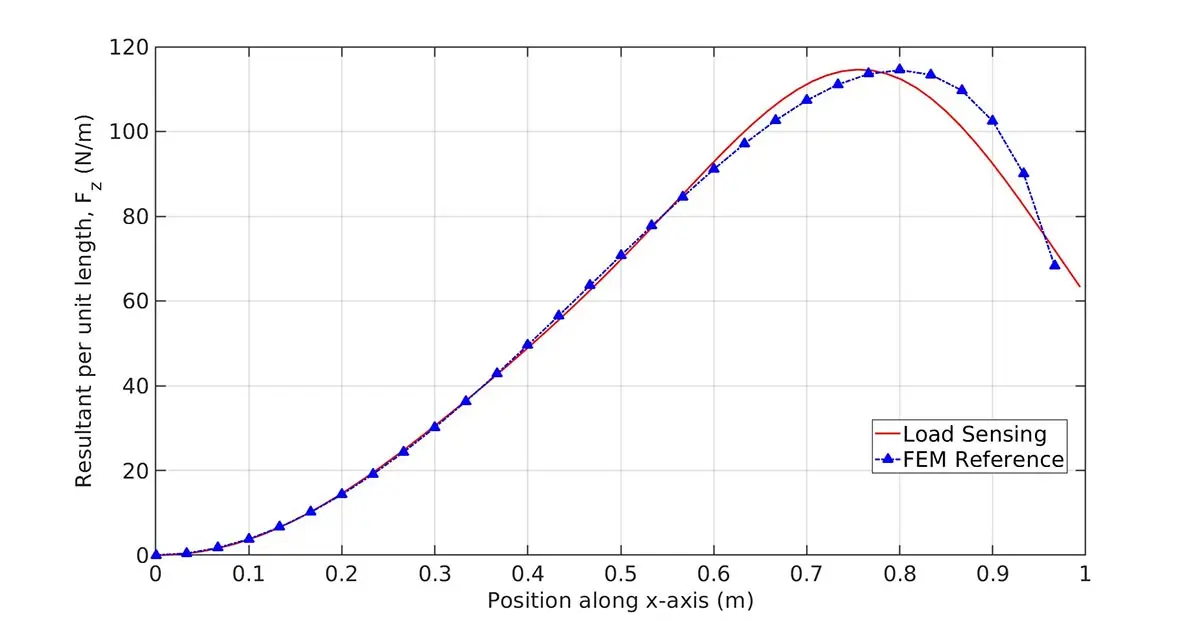
Preliminary results, presented at the CEAS-AIDAA joint conference held in December 2025 in Turin, demonstrated sub-percent accuracy in blade shape reconstruction and load estimation errors below 5%, confirming the strong potential of the proposed approach. Ultimately, the BeSaME project aims to contribute to improved flight safety, reduced maintenance costs, and lower noise emissions, in line with the ACARE Flightpath 2050 objectives and the Italian National Advanced Air Mobility strategy.
For more information: P. Masarati, E. Casciaro, A. Cocco, R. Sutov, P. Bettini, A. Zanotti, G. Bernardini, F. Liguori, J. Serafini, "From Strain Measurements to Rotor Blade Shape and Loads Reconstruction: the BeSaME Project", CEAS/AIDAA 2025, Turin, Italy, December 1-4, 2025
Contributions
The project is funded under the PRIN 2022 program and is jointly carried out by Politecnico di Milano and Università degli Studi Roma Tre. The two research groups have a long-standing collaboration, particularly in the field of rotorcraft aeromechanics.
DAER Contribution:
- Project management
- Blade manufacturing and instrumentation
- Rotor assembly and instrumentation
- Functional checks and experimental campaign
- Test data analysis
- Numerical simulation in support of the experimental activity
RomaTre Contribution:
- Aeroelastic modeling
- Inverse finite element analysis
- Virtual sensing
- Test data analysis
- Numerical simulation in support of the experimental activity
Personnel:
Politecnico di Milano
- Pierangelo Masarati (PI)
- Paolo Bettini
- Emanuele Casciaro
- Alessandro Cocco
- Donato Grassi
- Mattia Meroli
- Paolo Rubini
- Roman Sutov
- Alex Zanotti
Università degli Studi Roma Tre
- Giovanni Bernardini (co-PI)
- Francesco Liguori
- Claudio Pasquali
- Jacopo Serafini
SDGs covered:
#9 – Industry, Innovation and Infrastructure
#12 – Responsible Consumption and Production