Biological structural materials often feature a combination of compliant and rigid phases.
Their arrangement in hierarchical and complex architectures leads to excellent structural properties, ranging from high stiffness, high load bearing capacity, and fracture resistance.
Many natural materials, over the course of evolution, independently developed similar strategies and design principles to achieve these properties, from topologically interlocking structures to architectures that deflect incoming cracks.
Taking inspiration from natural superior designs, in my talk I will highlight how a new class of two-phase composites can be designed, manufactured and characterized.
These composites display controllable mechanical [1], fracture [2], impact [3], and load-bearing behavior [4], and prove to be a fascinating new platform to generate structural materials with tailorable structural behavior.
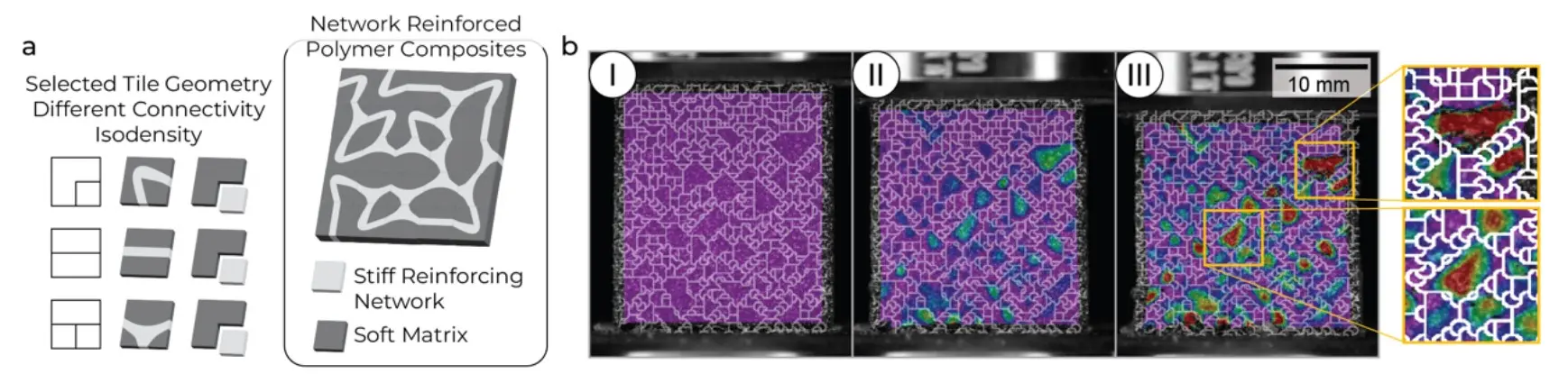
The composites are designed using stochastic algorithms of virtual growth (VGAs), capable of tiling a confined space (a square-grid) using pre-selected tile geometries and adjacency rules that determine their connectivity (Figure 1a).
The generated designs are manufactured into specimens using multi-material additive manufacturing [1], using a rigid polymer for the reinforcing network and a soft elastomeric matrix to fill the gaps, and their properties characterized in quasistatic and dynamic testing conditions [1-3] (Figure 1b).
In my talk, I will highlight how tuning the geometry and the topology of the reinforcing networks provides a high degree of control on the final properties of the composites, allowing their design for target stiffness and strength [1], for specific mechanisms of fracture energy dissipation [2], for absorbing energy during impacts, [3] and for the selective activation of different load bearing behaviors[4].
References:
[1] T. Magrini*, C. Fox, A. Wihardja, A. Kolli, C. Daraio*. “Control of Mechanical and Fracture Properties in Two-phase Materials Reinforced by Continuous, Irregular Networks”. Advanced Materials, 2023.
[2] C. Fox, T. Magrini* and C. Daraio*. “Tailoring the fracture response of two-phase network reinforced composites through irregularity”. International Journal of Solids and Structures, 2025
[3] C. Fox, K. Chen, M. Antonini, T. Magrini* and C. Daraio*. Extracting Geometry and Topology of Orange Pericarps for the Design of Bioinspired Energy Absorbing Materials. Advanced Materials 2024.
[4] C. Fox, K. Bastawros, T. Magrini* and C. Daraio*. "Controllable interlocking from irregularity in two-phase composites” Matter, 2025.
Speaker:
Since 2024, Tommaso Magrini is Assistant Professor in the Department of Mechanical Engineering at the Eindhoven University of Technology (TUe), where he leads a team that focuses on the multiscale design, fabrication and characterization of architected materials and composites. Before joining TUe, Magrini was a Swiss National Science Foundation (SNSF) Postdoc Mobility Fellow in the Department of Mechanical Engineering at the California Institute of Technology (Caltech), in the team of Prof. C. Daraio. Before Caltech, Magrini conducted his PhD in Materials Science at ETH Zurich (ETHZ), with the thesis: ‘Tough and Transparent Nacre-like Functional Composites’, in the group of Prof. A. Studart. During his PhD, he was awarded the Silver Graduate Student Award by the Materials Research Society (MRS), for excellence and distinction during the doctoral studies.