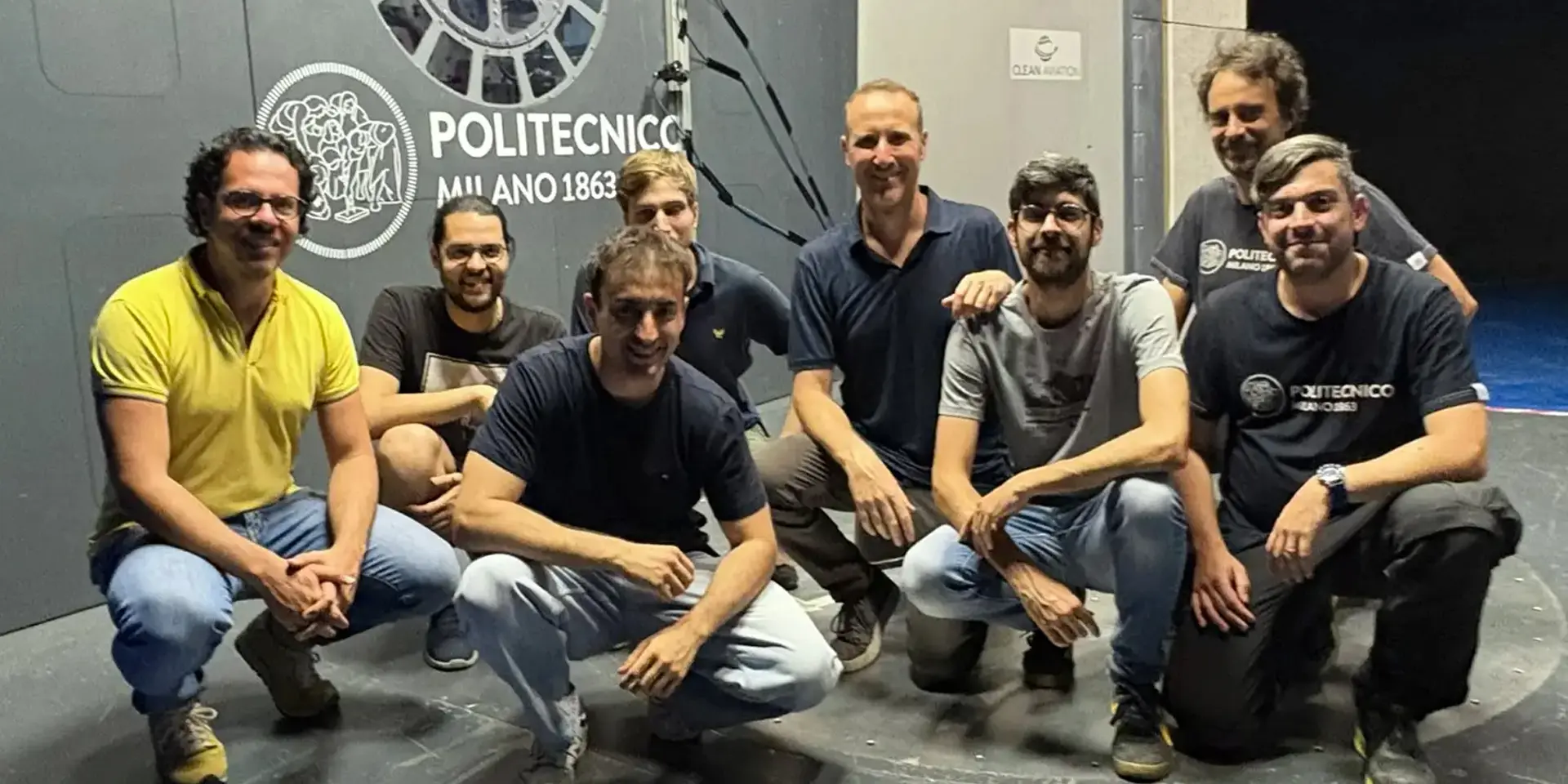
The tests confirmed the complete functionality of highly innovative morphing ailerons under representative aerodynamic conditions, validating the design, development, and integration activities carried out at Politecnico di Milano by Alessandro De Gaspari and Vittorio Cavalieri over the past three years.
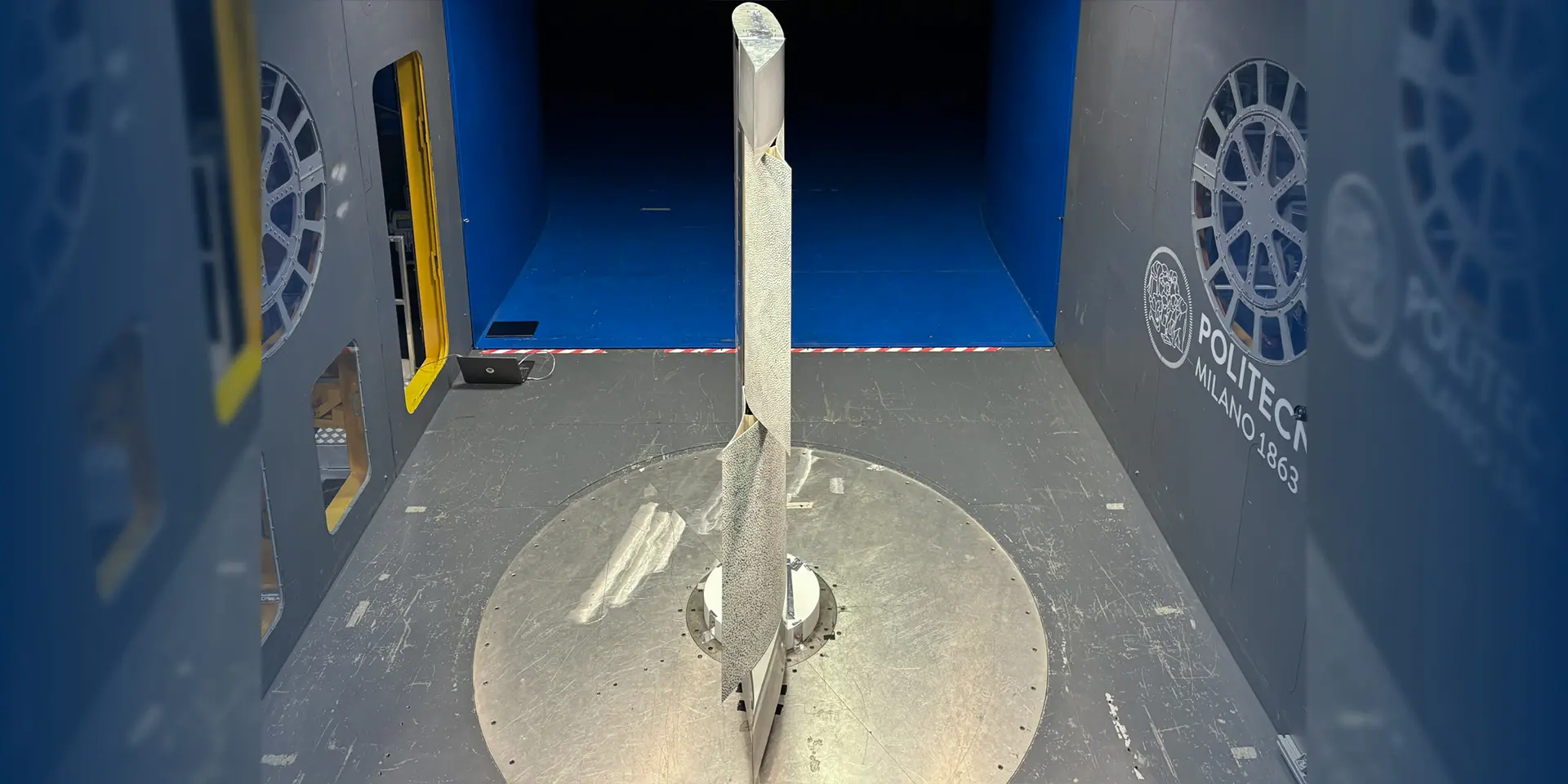
HERWINGT is a European project within the Clean Aviation programme under Horizon Europe. The 10-day experimental campaign was carried out in the large wind tunnel facility at Politecnico di Milano and focused on the outer 2.5-metre section of the innovative wing designed for the Clean Aviation regional aircraft.
The representative full-scale morphing wing demonstrator is equipped with two servo-actuated morphing ailerons based on compliant structures, driven by dedicated kinematics and electromagnetic motors. The system provides an overall actuation bandwidth of up to 10 Hz. The tests demonstrated the ability of the morphing ailerons to exploit structural flexibility to achieve the target shape changes, while maintaining sufficient stiffness and robustness to preserve the commanded shapes under external aerodynamic loads.
The campaign addressed several key research objectives, including the aerodynamic characterization of the morphing wing, the assessment of load control capabilities, the investigation of the static and dynamic response of the system, the analysis of step-command response and actuation bandwidth, and the study of aerodynamic hysteresis effects associated with oscillating morphing trailing-edge surfaces.
The morphing ailerons were designed to reduce the required actuation forces in both static and dynamic conditions, potentially enabling the future use of lighter and more compact actuators. In particular, the devices exploit structural flexibility also from a dynamic perspective, reducing the actuation forces required as the actuation frequency increases and making static loads the sizing condition for the actuators.
The demonstrator was instrumented with accelerometers, actuator position and force sensors, and a RUAG strain-gauge balance to measure the loads transmitted through the wing. Siemens Digital Industries Software supported the campaign with a camera-based instrumentation system installed in the wind tunnel test section. Their Digital Image Correlation system enabled the identification and reconstruction of the morphing shapes under aerodynamic loads, with aileron deflections of up to 14 degrees.
This campaign represents a major step towards the experimental validation of morphing wing technologies for future regional aircraft, bringing together morphing structures, advanced actuation, experimental aerodynamics, and high-fidelity optical measurement techniques on a representative full-scale wing demonstrator.