
Lunar exploration is blooming. Various national space agencies (China, India, Russia, etc) are sending robotic landers to the moon and executing sample-return missions, bringing back lunar regolith samples to Earth.
In the US, NASA is presently running the Commercial Lunar Payload Services (CLPS) program, partnering with commercial companies to bring scientific payload to the moon.
These robotic landers are a prelude to human exploration. The NASA Artemis program is presently in its Artemis II phase (crewed flight around the moon), while Artemis III will see astronauts stepping on our satellite and conducting scientific experiments. Among the various science questions, the study of volatile species emanating from the regolith (such as Ar40, Ne, H2, H2O) has a special importance and could explain the presence of water ice detected at the lunar poles via remote observations, with direct implications on future In-Situ Resource Utilization (ISRU) operations.
In order to answer such scientific questions, it is imperative to identify the effect of anthropogenic contamination on the otherwise pristine lunar environment. Propulsion-system plumes deposit large quantities of chemicals, including molecular water, on the cold lunar surface. For instance, preliminary estimations suggest that, during descent, Starship HLS would deposit up to 14 metric tonnes of molecular water within an 8 km radius. This anthropogenic water would swamp the natural abundance of exospheric species and entirely compromise the outcome of mass-spectrometetric or vacuum-pressure-gauge measurement campaigns. Additionally, outgassing from the spacecraft thermal blanketing and from the solar panels is also a significant source of contamination. Outgassing rates, which are particularly high during the lunar day, might preclude astronauts from performing mass-spectrometric measurements at distances below hundreds of meters from the landing point.
This presentation will focus on some recent studies performed at NASA Goddard Space Flight Center, including
- an analysis of the failure of the Peregrine Mission-One (2024) and the measurements performed with the PITMSmass spectrometer,
- an overview of the gas-dynamic regimes associated with rocket-plume expansion
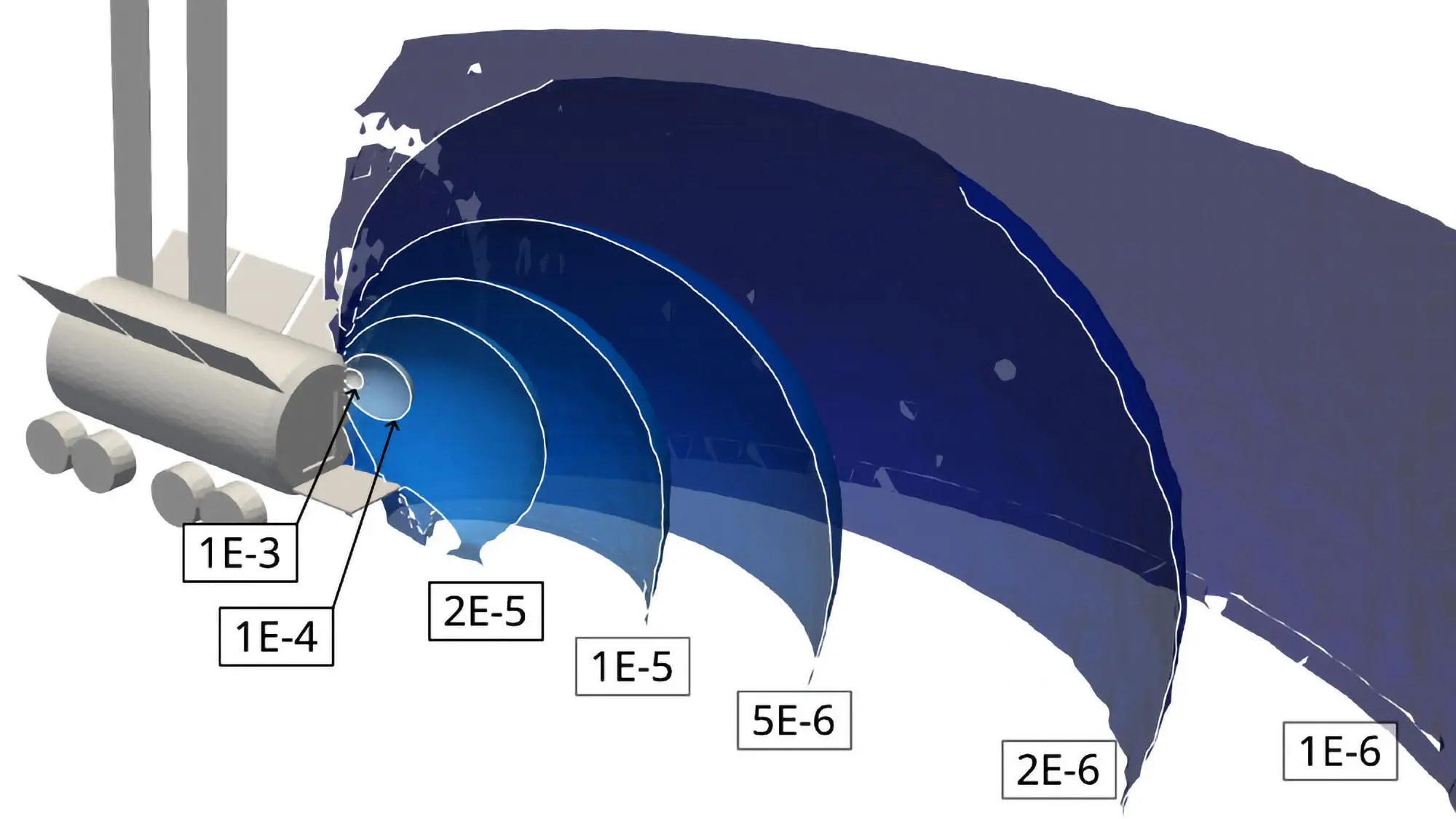
- numerical simulations of the long-distance contamination caused by venting operations and outgassing from pressurized rovers and lunar modules.
SPEAKER
Dr. Stefano Boccelli, NASA Goddard Space Flight Center.
Free admission, open to all members of the university community and the public, subject to availability.
19.1.2026