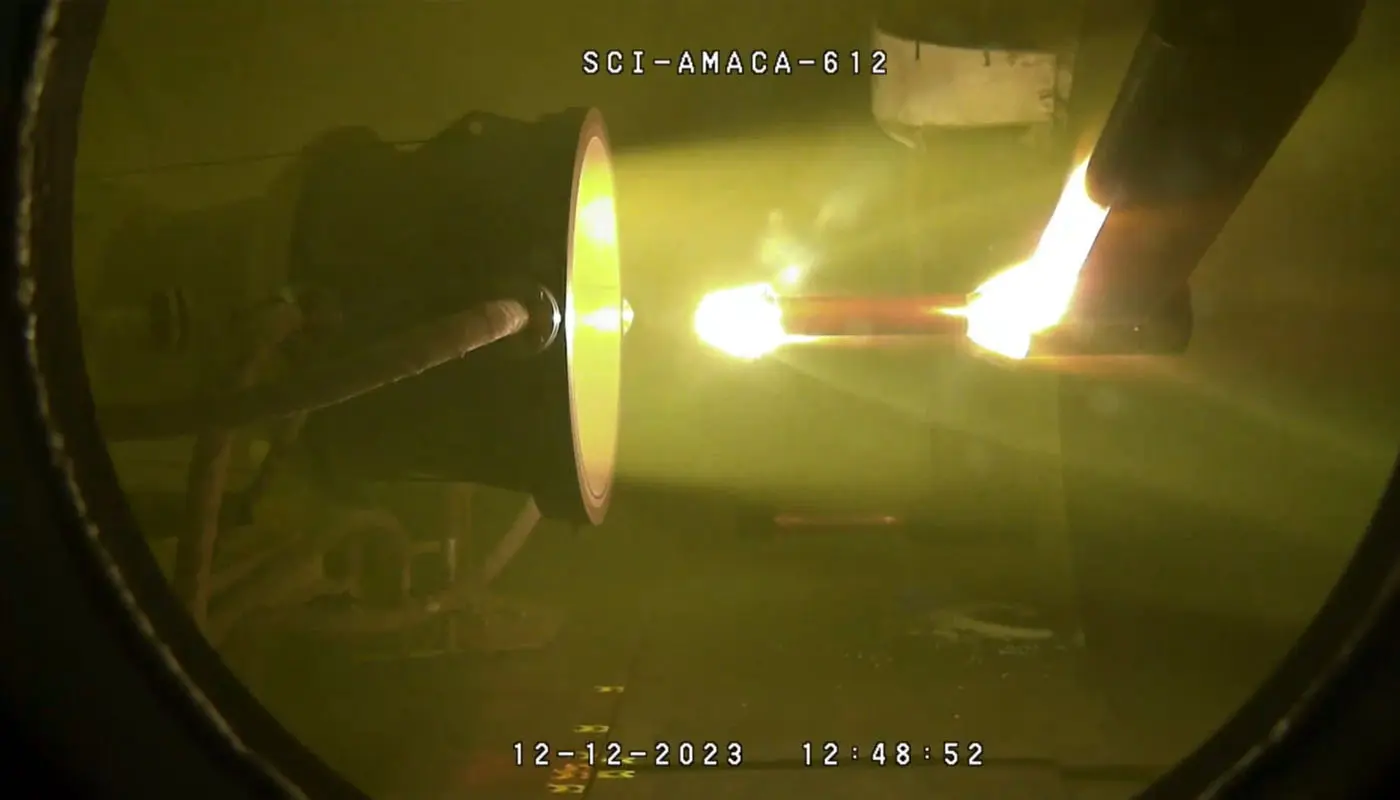
Reducing the cost of access to space through the use of reusable spacecraft is one of the goals of the AM3aC2A project (Multiscale Approach for Modelling CMC and UHTCMC Materials for Reusable Components for Aerospace), which has taken significant steps towards the development of vehicles capable of safely carrying out multiple space missions with no need for sophisticated inspections or maintenance over a period of more than three years.
AMACA has defined experimental and numerical methods for developing thermostructures made of ceramic composites (carbon fibre in a ceramic matrix), capable of withstanding high temperatures (1000°C÷2000°C), i.e., under the typical conditions of re-entry from space missions, hypersonic flight and propulsion systems.
Today, the materials analysed make it possible to create lightweight, highly rigid structures with damage tolerance characteristics that are extremely greater than those of common ceramics.
The AMACA project was funded by the Italian Space Agency (ASI) and is jointly led by Department of Aerospace Science and Technology of the Politecnico di Milano; CIRA, Italian Aerospace Research Centre; ISSMC, Institute of Science, Technology and Sustainability for the Development of Ceramic Materials of the CNR; and Petroceramics S.p.A.