
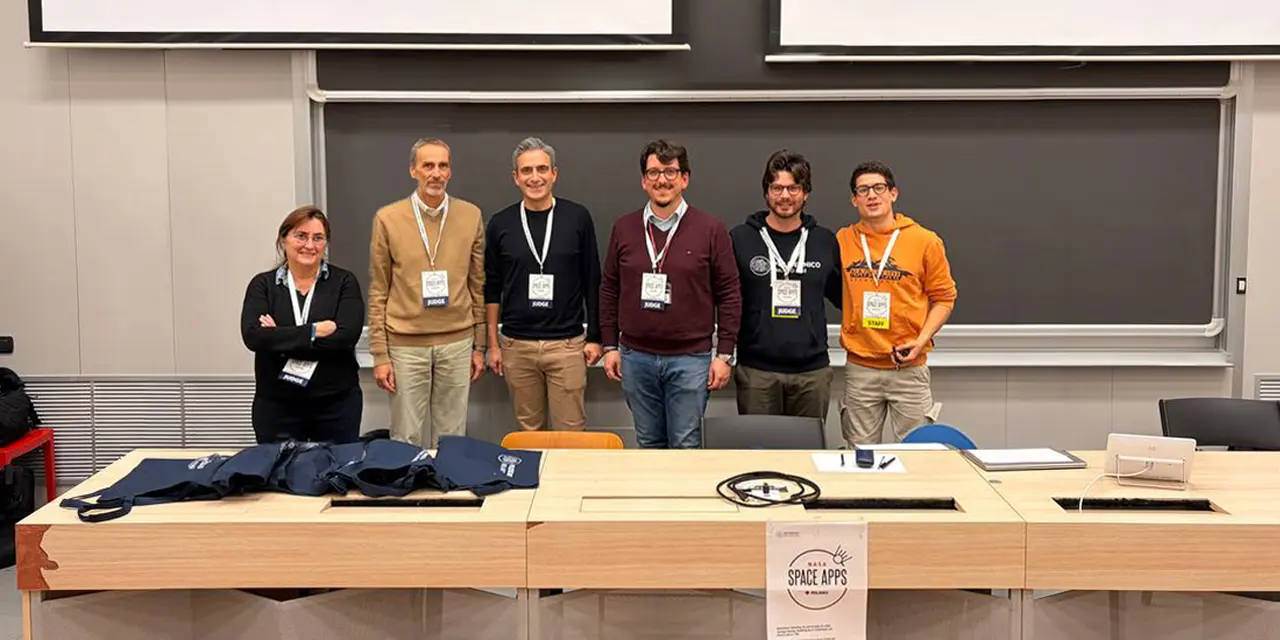
Over the 48-hour hackathon, 40 teams took on a range of scientific and technological challenges, producing 29 projects, many of which stood out for their quality, practical applications and potential scientific impact.
The judging panel included five academics from the Department of Aerospace Science and Technology (DAER) at Politecnico di Milano – Franco Bernelli, Andrea Colagrossi, Stefano Silvestrini, Pierluigi Di Lizia and Michèle Lavagna – supported by around ten DAER PhD students. Together, they shortlisted ten finalist teams, who each had two minutes to pitch their projects before answering questions from the judges.
Following the final pitches, three teams were chosen to go forward to the global round of the NASA Space Apps Challenge:
- I CorSARi, who developed a way of turning astronomical images into music, making space data more accessible to blind and visually impaired people.
- ExoPlay, who created an interactive game that uses gamification to make space systems design more engaging.
- WIFA Robotics, who developed an app that uses satellite data to monitor agricultural crops.
Five awards at the Milan event
Alongside the selection of teams for the global competition, the judges presented five local awards recognising creativity, technical innovation, scientific merit and the ability to communicate ideas effectively:
- Best Local Team – I CorSARi: for turning astronomical images into musical experiences that make space data accessible to blind and visually impaired people.
- Best Young Team – Astraman: awarded to a 13-year-old participant who impressed the judges with his design for a lunar base.
- Best Use of Science – AstroBOO: for using multispectral data from NASA satellites to help prevent wildfires.
- Best Storytelling – Martian Pineapple: for creating a Google Maps-style platform for exploring and navigating the surface of Mars.
- Best Use of Technology – LYRA Project: for developing a facial recognition system to monitor astronauts, complete with a live demonstration.
The winning teams received gifts and merchandise from Politecnico di Milano and its Department of Aerospace Science and Technology.
Bringing people together through science and innovation
The Milan edition of the NASA Space Apps Challenge showed how much can be achieved when people from different backgrounds, disciplines and age groups come together. It gave participants the chance to tackle real-world problems, share ideas and find new ways of using space data and technology.
From planetary exploration and environmental sustainability to accessibility and astronaut health, the projects showed how advances in aerospace research can make a real difference, both in space and here on Earth.
The event also brought education, research and innovation closer together, helping to inspire the next generation and encourage a passion for space and science..