Participation is free of charge, but registration is required and subject to seat availability.
For those unable to attend in person, the event will also be available via live streaming.
[WATCH THE LIVE STREAM – LINK AVAILABLE SOON]
On 25 November, Politecnico di Milano will host a special event in its Aula Magna, made possible thanks to the support of the Italian Space Agency (ASI) and dedicated to the European Space Agency's (ESA) Hera mission, marking the world premiere of the first images of asteroid Dimorphos following the impact of NASA's DART spacecraft in 2022.
Organised as an exclusive partner event, under the patronage of ESA and in collaboration with ASI, the initiative will offer the public the opportunity to witness a significant moment in space exploration and planetary defence through a live connection with the international event taking place in Berlin.
The evening will feature Paolo Nespoli, astronaut, and Giovanni Caprara, science journalist and communicator, alongside researchers Paolo Panicucci and Iosto Fodde from the DART Lab of the Department of Aerospace Science and Technology at Politecnico di Milano. They will guide the audience through the Hera mission, exploring its objectives, technological challenges and the University's contribution.
The DART Lab coordinators, Prof. Francesco Topputo , responsible for Milani’s guidance and navigation system, and Prof. Fabio Ferrari, scientific lead of the Milani NavCam, will attend the international event in Berlin.
During the event, Milan will connect live with Berlin and other participating European cities to share the excitement of this discovery in real time. The highlight of the evening will be the unveiling of the first close-up images of Dimorphos following DART's impact, broadcast live by ESA.
From DART to Hera: Understanding Asteroids to Protect Earth
In September 2022, for the first time in history, humanity succeeded in deliberately altering the motion of a celestial body. NASA's DART spacecraft struck Dimorphos, the small moon of asteroid Didymos, demonstrating that an asteroid's trajectory can be altered through a controlled impact.
The experiment was a success: the collision shortened Dimorphos's orbital period around Didymos by approximately 33 minutes. However, one question remained unanswered: what actually happened to the asteroid after the impact? Did a crater form, or did the collision completely reshape it?
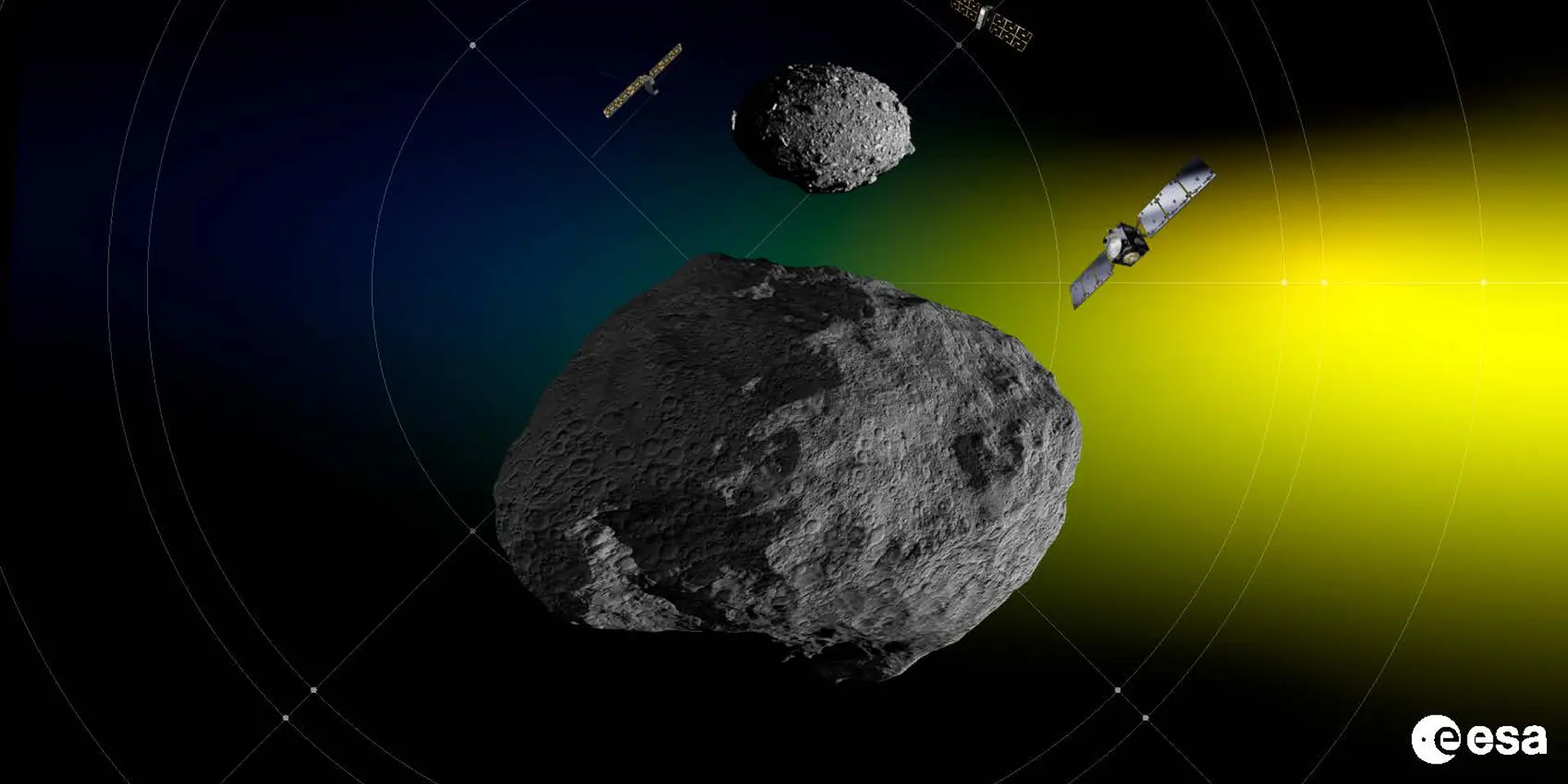
Four years later, ESA's Hera mission is ready to provide the first answers. By reaching the Didymos–Dimorphos binary asteroid system, the spacecraft will closely investigate the physical characteristics of both asteroids and the consequences of the impact, gathering crucial data to assess the effectiveness of the kinetic impactor technique.
Hera thus represents the second phase of an international planetary defence programme aimed at developing the knowledge and technologies needed to protect Earth from potential asteroid threats.
Politecnico di Milano's Contribution to the Hera Mission
Politecnico di Milano is directly involved in the mission through Milani CubeSat, one of the two small satellites accompanying Hera in its exploration of the asteroid system.
Milani’s trajectories and guidance system were designed at Politecnico di Milano, which is also responsible for the scientific oversight of the Milani NavCam and is part of the science team responsible for analysing the data collected by the mission to deepen our understanding of the structure and properties of binary asteroids.
The University's involvement highlights the contribution of Italian research to an international mission that brings together space exploration, technological innovation and planetary defence.